Who Is Narendra Modi?
Narendra Modi is the Prime Minister of India and one of the most influential political leaders in modern Indian history. Known for his strong communication style, bold policy decisions, and global outreach efforts, Modi has shaped India’s political and economic direction over the past decade.
Since taking office in 2014, he has focused on economic reforms, digital transformation, infrastructure growth, and strengthening India’s position on the global stage.
Early Life and Political Background
Narendra Modi was born on September 17, 1950, in Gujarat. Before becoming Prime Minister, he served as the Chief Minister of Gujarat from 2001 to 2014.
He is a senior leader of the Bharatiya Janata Party (BJP), a major national political party in India. His rise within the party was marked by organizational work, grassroots engagement, and strong leadership during state elections.
His 2014 general election campaign focused heavily on development, governance reform, and economic growth, themes that continue to define his political narrative.
Major Policies and Reforms Under Narendra Modi
1. Digital India Initiative
The Digital India campaign aimed to expand internet connectivity, promote digital payments, and modernize government services. It significantly boosted UPI transactions, digital banking, and online governance systems.
2. Goods and Services Tax (GST)
The introduction of GST was one of the biggest tax reforms in India’s history. It unified multiple indirect taxes into a single system, aiming to simplify business operations and improve tax compliance.
3. Make in India
Launched to boost manufacturing and attract foreign investment, Make in India focuses on transforming India into a global manufacturing hub.
4. Infrastructure Development
Under Modi’s leadership, India has seen expansion in:
- National highways
- Railway modernization
- Airport development
- Smart city projects
Infrastructure spending has been a key pillar of his economic strategy.
5. Foreign Policy & Global Positioning
Modi has actively worked to strengthen India’s global relationships, engaging with countries such as the United States, Japan, Australia, and European nations. India’s participation in global forums like the G20 has also gained visibility.
Leadership Style and Public Image
Narendra Modi is known for:
- Direct communication through social media
- Strong nationalistic messaging
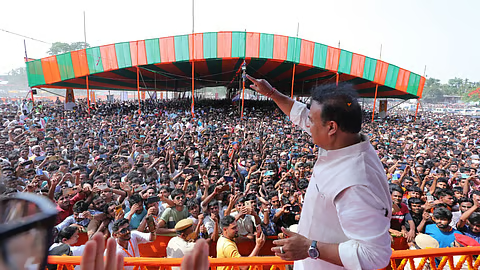
- Mass rallies and public engagement
- Centralized decision-making
His supporters view him as a decisive leader focused on national growth and global recognition. Critics, however, question certain policy decisions and governance approaches.
His leadership style has made him a dominant figure in Indian politics, influencing both national and state-level political dynamics.
Electoral Performance
Modi led the BJP to major victories in:
- 2014 General Elections
- 2019 General Elections
His campaigns often emphasize development, welfare schemes, national security, and economic reforms.
Key Welfare Schemes
Several welfare programs launched during his tenure include:
- Financial inclusion initiatives
- Rural electrification projects
- Housing schemes for low-income families
- Health insurance expansion
These schemes aim to improve living standards and expand access to basic services.
Challenges and Criticism
Like any major political leader, Narendra Modi has faced criticism on issues such as:
- Economic slowdown concerns
- Unemployment rates
- Agricultural sector reforms
- Social and political debates
Political analysts continue to evaluate the long-term impact of his policies.
Narendra Modi’s Role in Modern Indian Politics
Narendra Modi has reshaped political communication in India by combining traditional campaigning with digital outreach. His ability to connect with both urban and rural voters has strengthened his political base.
Whether viewed as a transformative reformer or a polarizing leader, his influence on India’s governance model is undeniable.